For more than a decade, Collaboration for Impact (CFI) has worked alongside communities across Australia to strengthen community-led systems change. We have seen extraordinary examples of local leadership, collective agency and communities reshaping the systems that affect their lives.
Yet one question has increasingly challenged our thinking.
What if community-led systems change, as it is predominantly practised today, is not enough?
Not because community agency is not essential—it is. Communities remain the primary source of leadership, innovation, and lasting change. But we have seen that communities alone cannot transform systems whose foundations were built on relationships that were never peaceful or equitable to begin with.
Australia was established through dispossession, not peaceful settlement. Those foundations continue to shape our institutions, our public narratives and, often below the surface, the way we approach change today.
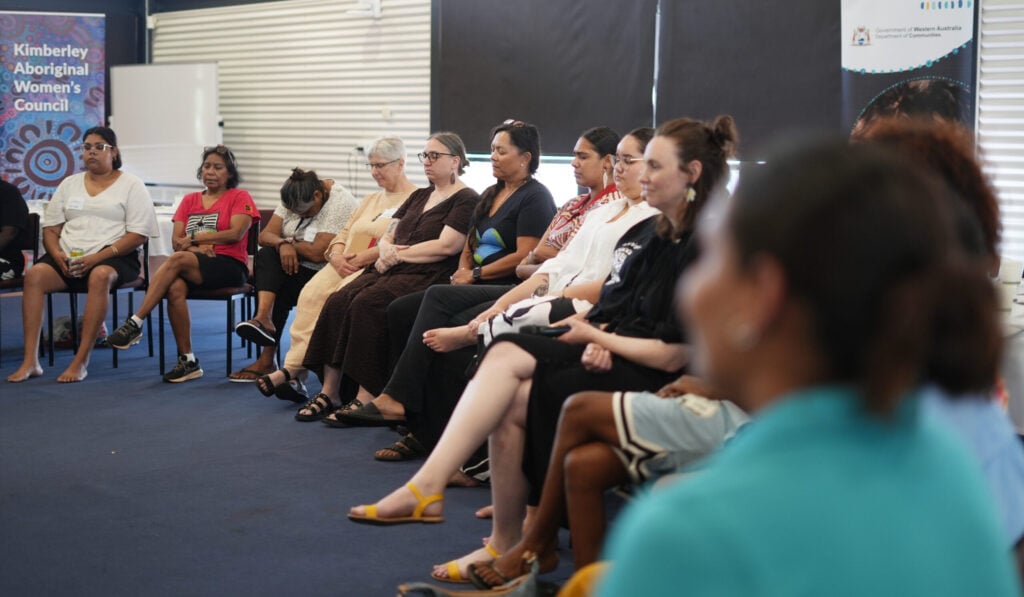
Our exploration of peacebuilding began in 2024 through our partnerships with First Nations leaders and communities who were already leading this work. As we worked alongside the Kimberley Aboriginal Women’s Council to strengthen Aboriginal community leadership, and learned from peacebuilding practitioner Janine Dureau, we came to recognise that lasting systems change requires more than community agency alone. It also requires the patient work of healing relationships, transforming conflict, addressing historical and ongoing injustices, and changing how institutions share power with communities.
This is the work of peacebuilding. By peace, we do not mean the absence of conflict. We mean the ongoing work of transforming relationships, structures and ways of being so that truth, justice, belonging and shared futures become possible.
These experiences did not take us away from community-led systems change. They deepened our understanding of what it takes for communities—and ultimately our country—to build a future where everyone belongs.
The need for exploring peacebuilding was further reinforced by the ongoing aftermath of the Voice referendum. The Referendum did not create these divisions. It revealed—and at times intensified—tensions that had long existed beneath the surface of Australian society.
It also strengthened our conviction that peacebuilding deserves greater attention as part of community-led systems change.
The path toward that future where everyone belongs begins with a willingness to question some of the myths we’ve inherited about ourselves and each other.
Myth 1: Australia is already at peace.
Australia is fortunate not to be experiencing war in the conventional sense. But that does not mean we are a country at peace. The violence of colonisation, dispossession and the denial of sovereignty is not simply historical. Its consequences continue through inequitable systems, racism, trauma and exclusion. Peacebuilding asks us to understand peace not only as the absence of violence, but as the presence of just relationships, equitable structures, collective wellbeing and belonging.
Myth 2: Peacebuilding is for countries at war.
Peacebuilding is often understood as something that happens overseas. Yet Australia already holds generations of peacebuilding knowledge and practice. First Nations peoples have long practised it through kinship, governance, healing and care of Country. Our work alongside the Kimberley Aboriginal Women’s Council has reinforced that this knowledge is contemporary and alive. We have seen communities strengthening leadership while working on truth-telling, personal, family and community healing, as well as reshaping relationships with governments and service systems. This is all peacebuilding.
Myth 3: Peacebuilding is the work of First Nations Australians alone.
First Nations leadership is, and must remain, central. At the same time, peacebuilding is not the responsibility of First Nations Australians alone.
It calls for shared leadership between First Nations and other Australians, grounded in equitable ways of working together across cultures.
Peacebuilding asks settlers and other non-Indigenous Australians to engage with this work by examining their histories, naming their responsibilities, changing the institutions they influence and building honest, just relationships.
Myth 4: Place-based and community-led approaches alone can create equitable and thriving communities.
Community-led systems change is necessary and powerful. But communities should not be expected to solve problems created by broader systems of power. Community leadership must be built on truthful and repaired relationships and be accompanied by changes in governance, public institutions, philanthropy, resource flows and decision-making authority.
Taking the conversation into ChangeFest
These reflections are not conclusions. They are an invitation to learn together.
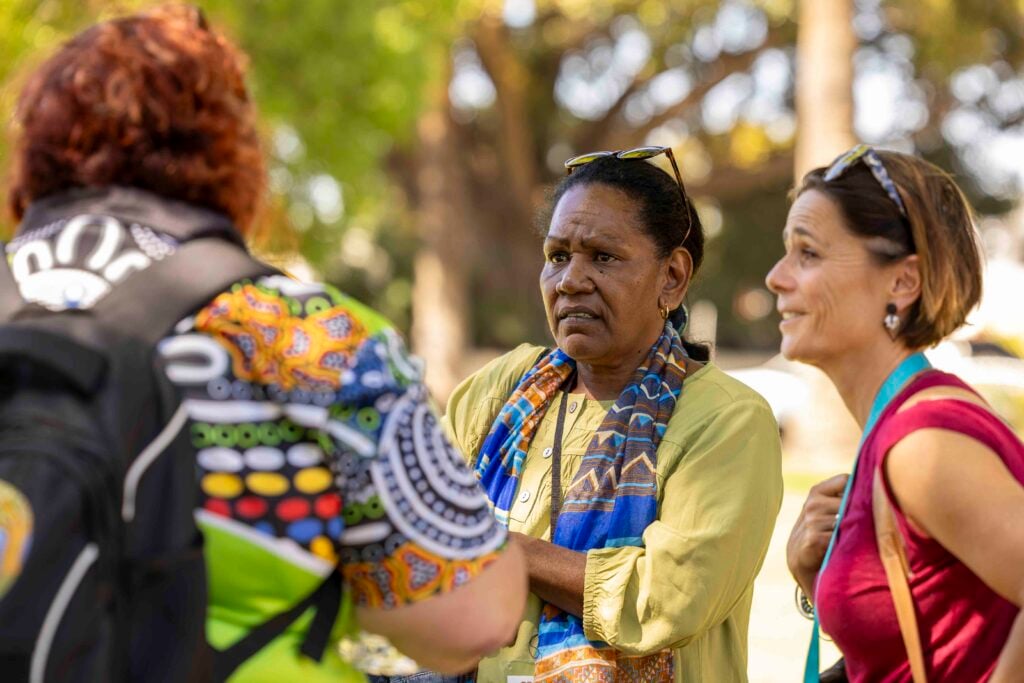
At ChangeFest 2025, Collaboration for Impact and the Wiyi Yani U Thangani Institute for First Nations Gender Justice co-facilitated a Peacebuilding Dialogue exploring what community-centred peacebuilding could mean in Australia.
The dialogue brought together people from communities, government, philanthropy and civil society to explore what it means to build peace in a country that has never reached a peaceful settlement, what peacebuilding practices are already alive within communities, and what distinct responsibilities First Nations and non-First Nations Australians carry.
What emerged was recognition that many people and communities have been practising peacebuilding for years without necessarily using that language, and that truth-telling, healing, community agency, shared leadership and belonging are deeply connected. They are helping shape a distinctly Australian practice of peacebuilding.
Continuing the work through ChangeFest
Peace-building and Healing is one part of Belonging for All – CFI’s broader strategy for strengthening the conditions in which everyone experiences belonging (learn more here).
Supporting the growing focus of community-led peace-building across the ChangeFest movement is a key way CFI expresses this commitment.
ChangeFest has a proven track record of bringing together First Nations leaders, communities, practitioners, public servants, funders and civil society to learn from one another, deepen relationships and strengthen practice. There is an opportunity to strengthen its role as a “third space” where difficult conversations about power, policy and funding can be held productively. It is within such a space that the conversations, relationships and action needed for peacebuilding can take shape.
This work recognises that peacebuilding is already being led by communities across Australia through truth-telling, healing, shared leadership, community organising and collective action. It is about creating a movement where these practices become more visible, more connected, and more strongly supported – and backed by sustained structural change and agreements to make this stick.
We believe this work is needed now more than ever. Australia is living through growing social division, declining trust, economic uncertainty, climate transition and increasing pressure on our democracy. Institutions alone cannot address these challenges. We need communities with the agency to shape their futures, relationships strong enough to hold difference, and institutions equipped and willing to share power and learn alongside communities.
Peace does not simply happen. Like a country where everyone is proud to belong, it is something we build—together.
Join CFI’s Anna Powell and Janine Dureau (PRF Fellow and Belonging for All Lead) at the next ChangeFest Lunch and Learn session (Tuesday 11 August 12.30pm AEST) as we explore what peacebuilding means in the Australian context, and what it asks of each of us as First Nations and settler/non-First Nations Australians. Register here.


